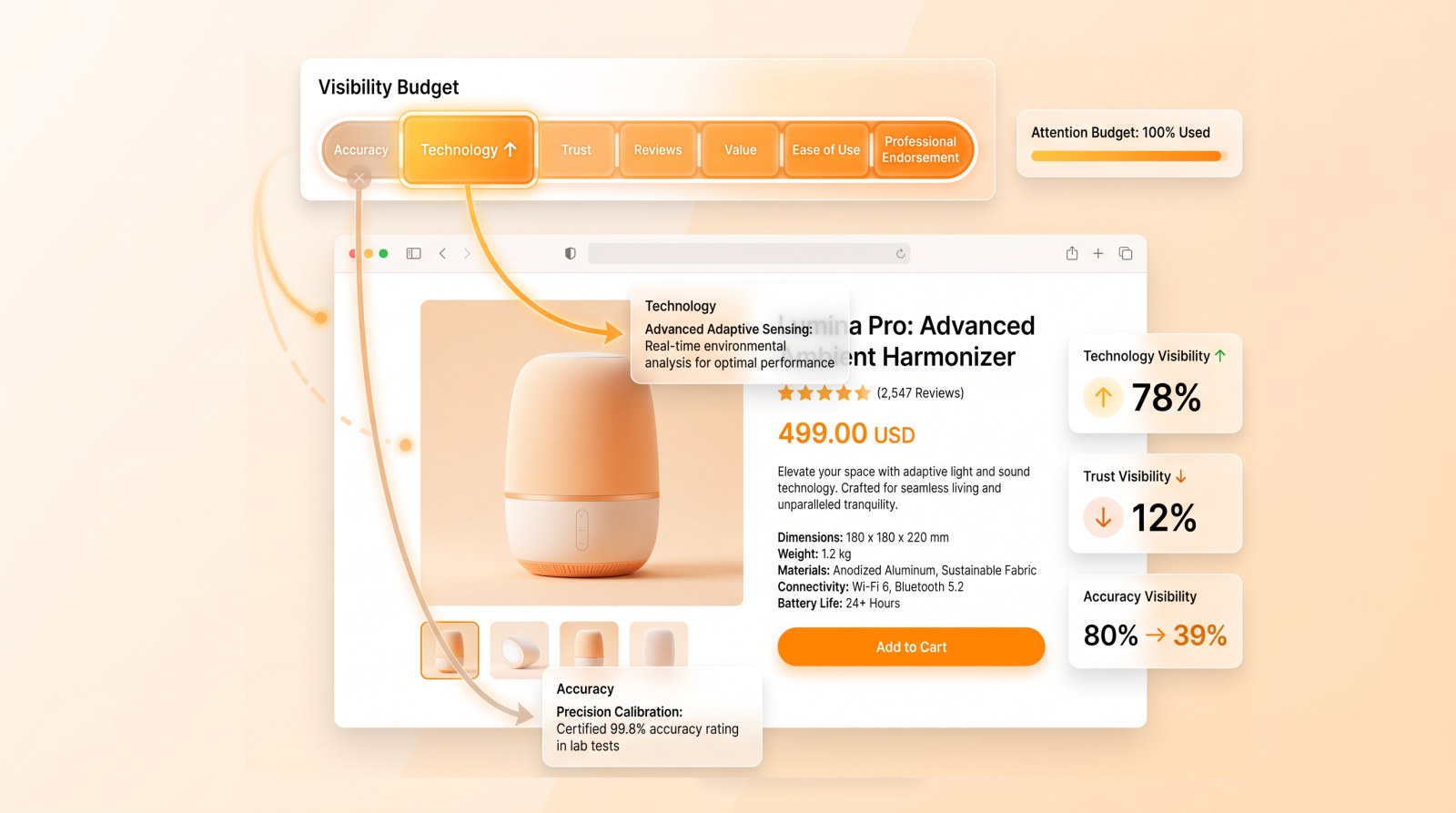
A brand refreshed the content on two product pages. The new version won on technology, won on value for money, won on ease of use, and lost on accuracy and trust. Nobody had removed the accuracy claim. They had removed it from the part of the page shoppers actually look at.
This is the most useful thing we know about product page optimisation, and it is almost always missed: a product page has a fixed attention budget. Shoppers do not read more because you write more. Every asset you add pushes another one down the gallery, and anything that moves far enough down effectively stops existing. Which means every new claim is not an addition. It is a trade.
What the refresh won, and what it paid
We tested the new content against the existing content in a live-feeling retailer environment, with shoppers browsing the category freely alongside competitors.
On performance the new content held the line: buying rate landed at parity with the control, and the brand's lead SKU stayed the category's best seller in both scenarios. No damage, no breakthrough.
On perception it moved a lot. Advanced technology rose significantly. Value for money rose with it, which is the interesting bit: nothing about the price had changed, but a product that feels more technical feels more worth its premium. Functional barriers came down too, with fewer non-buyers citing difficulty of use.
Then the bill. Concern about reliability of the result rose significantly among both buyers and non-buyers. Accuracy fell as a reason to buy. Perceptions of professional endorsement and of strong reviews both slipped. The brand had traded its oldest asset, being the one you can trust, for a newer one, being the one with the best technology.
The trade was mechanical, not creative
Because we measure how visible each individual asset is, we could see exactly where the trust went.
| Asset carrying the claim | Old content | New content |
| Headline accuracy claim (secondary image) | Seen by 80% of shoppers | Seen by 39% of shoppers |
| Accuracy claim (lower page module) | Seen by 79% of shoppers | Buried among other product features |
| Most-trusted claim (dedicated image) | Seen by 42% of shoppers | Dropped entirely |
In the old content, the headline accuracy claim was hard to miss. It appeared in a secondary image seen by 80% of shoppers, and again in a lower page module seen by 79%. In the new content, the same claim survives, but its main appearance is an image seen by 39%. It shows up again further down, buried among other product features.
The old content also carried a dedicated image making a most-trusted claim, seen by 42% of shoppers. The new content drops that seal entirely, keeping only a milder best-selling claim in the final image, where hardly anyone reaches.
Nobody decided to be less trustworthy. Someone made room for a better technology story, and trust was what got displaced. The perception data is just the arithmetic of that decision.
Why the usual review process cannot catch this
Content is signed off as a set of assets, viewed one at a time, at full size, by people who know what each one is for. Under those conditions every asset is visible and every claim is present. The page looks strictly better than the old one, because it is: each individual asset is stronger.
Shoppers meet the same assets in a fixed order, on a phone, while comparing four other products. Position is everything, and position is the one property that is invisible in the review deck. That is why so many content refreshes test at parity: the wins and the displacement losses cancel out, and everyone concludes the creative was the problem.
The competitive prize was real
None of this makes the refresh a mistake. Against the benchmark competitor it worked precisely as intended: the gap on perceived quality widened, the competitor became twice as likely to be seen as old technology, and the brand looked significantly easier to use. Its secondary images and lower page modules both converted better than direct competitors'.
The refresh bought a modernisation the brand wanted. It simply paid for it out of an account nobody was watching.
How to run this properly
Treat the gallery as a budget, not a container. Write down what each slot is currently buying you before you reorder anything.
Protect your non-negotiable claim by position, not by presence. If accuracy is the reason your category buys, an accuracy claim seen by 39% of shoppers is not a claim, it is a footnote. Ours needed integrating into an image already near the top of the gallery, and needed space of its own rather than a corner of a feature diagram.
And decide explicitly what you are willing to spend. Every refresh trades something. The only real failure is not knowing what.
The question to take into your next content review is not "is this better?" It is "what did we just push off the page, and can we afford to lose it?"