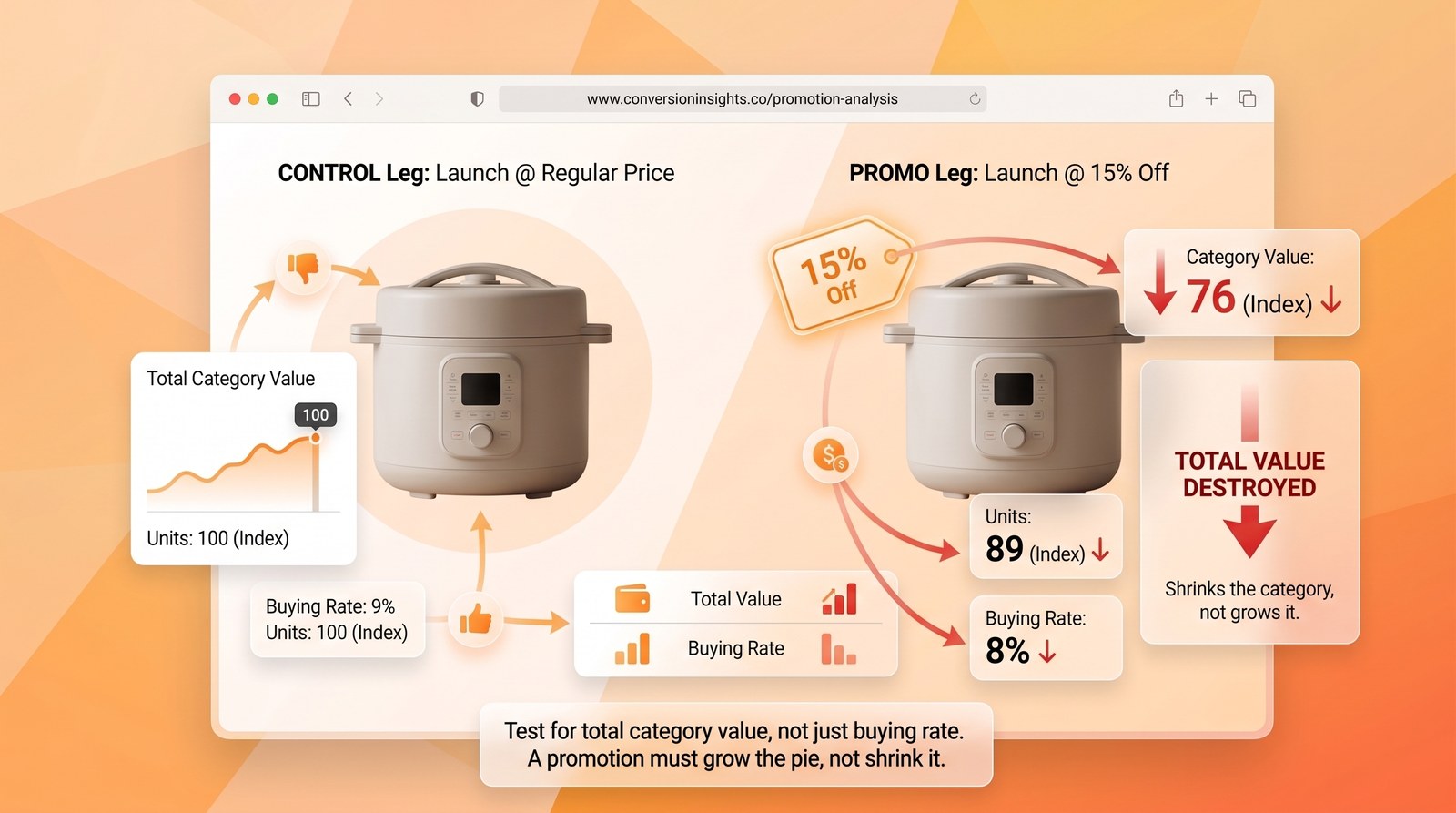
A 15% promotional discount on a new product launch produced fewer units sold, a slightly lower buying rate, and the lowest total category value of every scenario tested. On a dashboard built around conversion or buying rate alone, the promotion would have looked, at worst, neutral. It wasn't.
We tested four pricing and line-up scenarios for a new kitchen appliance launch on a simulated shelf: no launch (control), the new product at regular price, the new product at a 15%-off promotional price, and the new product in two colours at regular price. Shoppers in each scenario were different people running an independent shopping trip, so each leg is a clean read of what that price and line-up actually does to the category, not a discount layered on top of the same demand.
The numbers
| Kitchen appliance launch | Regular price | Promotional price (−15%) |
| Buying rate | 9% | 8% |
| Units sold, indexed to regular price | 100 | 89 |
| Total category value, indexed to regular price | 100 | 76 |
The promotional leg didn't just fail to grow the category, it generated less total value than every other scenario tested, including the no-launch control. The buying rate gap between regular and promo price was within the range you'd expect from ordinary sample noise. The value gap was not.
Why a 15% discount produced 24% less value
The mechanism is arithmetic, not psychology. A promotion only pays for itself if the lower price pulls in enough extra buyers to offset the lower price per unit. Here it didn't pull in extra buyers at all: unit sales were 11% lower under the promotion, not higher, so the entire 15% price cut flowed straight through to total value with nothing to offset it. The discount didn't expand the pie. It just gave away a slice of the pie that was already there.
A second case for a rule we've already argued
This is the same shape of result we found testing a mobile redesign that lifted conversion eight points and destroyed 11% of category value: a metric that looks fine, or even good, on the dashboard teams actually check, moving in the opposite direction from total value. That case was about a UX change; this one is about a price tag, on an unrelated product, in an unrelated country. Nothing about the shopping experience changed here at all. The only variable was the number on the price, and it was enough on its own to erase a quarter of the category's value.
What to check before you approve a promo
Model total category value, not buying rate or conversion in isolation, before a promotional price ships. Test the regular and promotional price as separate, independent scenarios rather than assuming a discount simply adds volume on top of what regular price would have done. And treat a promo whose buying-rate lift doesn't clearly clear its price cut as a value-losing scenario by default, not a neutral one, until the numbers say otherwise.