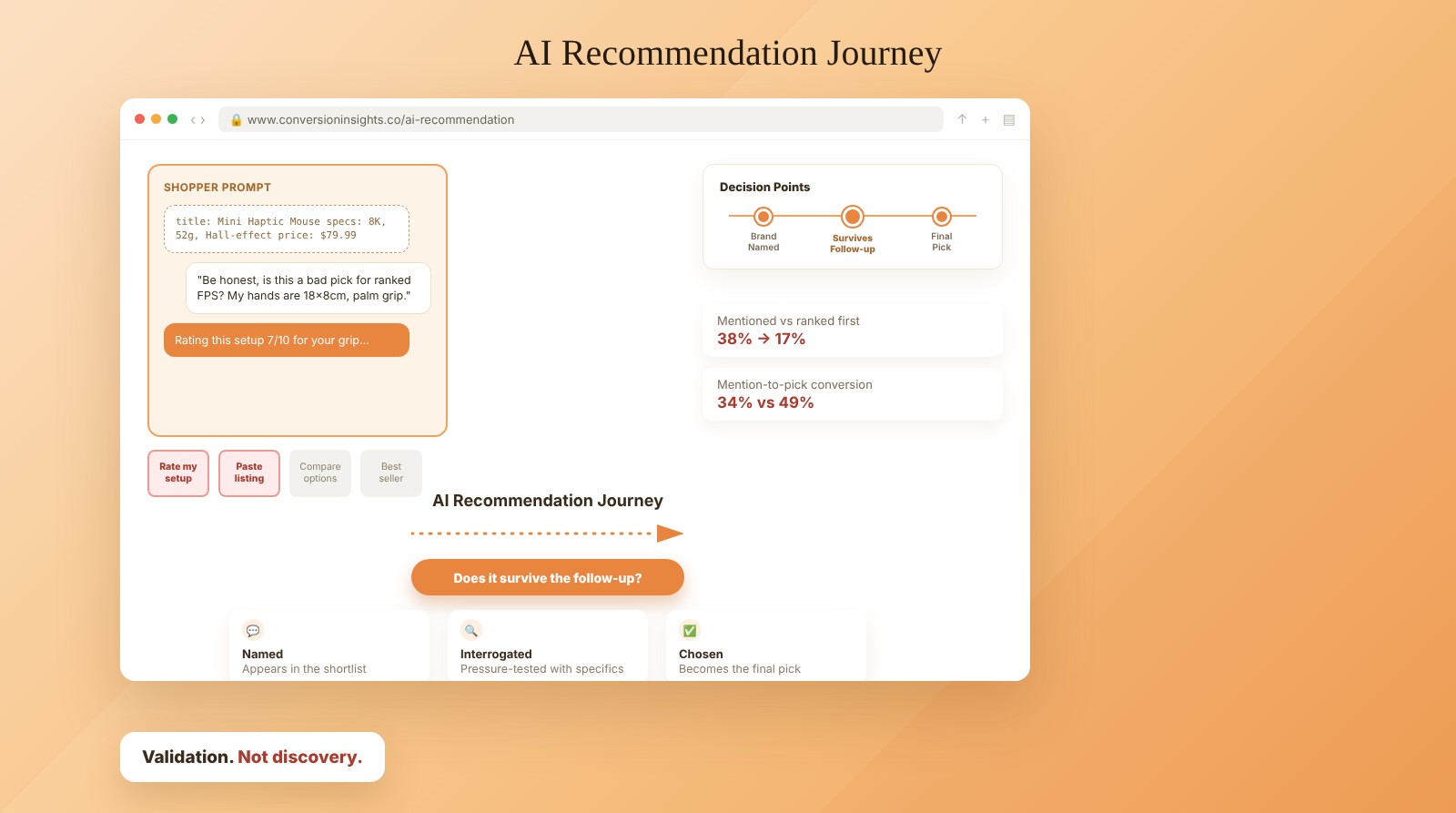
We had shoppers research real PC-peripheral purchases with an AI assistant, with no script and no scripted prompts. The clearest pattern in hundreds of conversations wasn't shoppers asking an assistant to discover a product. It was shoppers asking it to defend one they'd already half chosen. "Validation, not discovery" is the one-line summary, and the behaviour behind it is more specific, and more useful, than that sounds.
"Rate my setup out of 10"
In 52% of gaming-category sessions, the shopper's prompt was a confidence check on a choice already made, not a search for options: "rate my setup out of 10," "be honest, is this a bad pick." Another 51% front-loaded the same fixed personal spec into every prompt in the session, something like "my hands are 18x8cm, small and narrow, palm grip," expecting the assistant to tailor its answer to that exact person, not recite a best-seller list.
Two in five sessions went further and pasted a full retail listing, title, specs and price included, and asked the assistant to score it or pick a winner from a shortlist the shopper had already built themselves. The longest session in the study re-ran the same setup forty-six times, swapping one component at a time. That is not a shopper discovering a category. That is a shopper using the assistant as a test bench.
Being named isn't being chosen
Almost every session gets a shortlist: 98% of conversations name at least one brand in the first answer. But the assistant only commits to a single top pick in 61% of gaming sessions and 70% of productivity ones, and getting named is a long way from getting picked.
One gaming brand in the study was mentioned in 38% of sessions, more than every competitor except the category leader, yet ranked first in single-pick answers only 17% of the time, with an average position of 2.6 when it did appear. Its mention-to-pick conversion, the share of sessions naming it that ended with it as the shopper's final choice, was 34%. The category leader converted 49% of its mentions into a final pick; the next competitor converted 41%. Visibility and conversion are not the same metric, and the gap between them is where a brand actually wins or loses the sale.
Why follow-up questions are where brands lose ground
The mechanism behind that gap is the same validation behaviour from the top of this piece. Two in three gaming sessions name a specific game or mode so the assistant tailors its answer, and 30% explicitly demand blunt criticism, "no sugarcoating," rather than a sales pitch. When a shopper follows up with that kind of specific, skeptical pressure, a brand mentioned early has to survive it to stay on the shortlist.
The brand converting mentions worst in this study kept only 63% of its mentions after follow-up questions, against 80% for the category leader. Coded alongside the conversations, the single most common reason the assistant gave for dropping it after a follow-up was a companion-software or reliability concern, the kind of detail that only surfaces once a shopper has pushed past the first answer. Being named costs nothing. Surviving the cross-examination is the part that converts.
Even the final step is contested
When the assistant does link out to a retailer, the destinations are concentrated and uneven: two retailers took 60% of gaming-answer links in this study, while the largest marketplace took under 10% of either segment. Separately, that marketplace is known to block the crawlers AI assistants use to read live listings and reviews, which is a plausible part of why assistants route shoppers elsewhere even when asked for a pick from that marketplace specifically. Winning the recommendation and winning the destination are two different contests, and a brand can win the first and still lose the second if its retail presence isn't built where the assistant is actually willing to send someone.
What this means for how you show up
Optimising for mention rate alone chases the wrong number. The brands converting mentions into final picks are the ones that survive a shopper's follow-up questions, which means publishing the specific, checkable proof, specs, reliability data, direct answers to the objections your product actually gets, that an assistant can cite back when a skeptical shopper pushes on it. Getting named in the first answer is the easy part. The conversation after that is where the decision actually gets made.