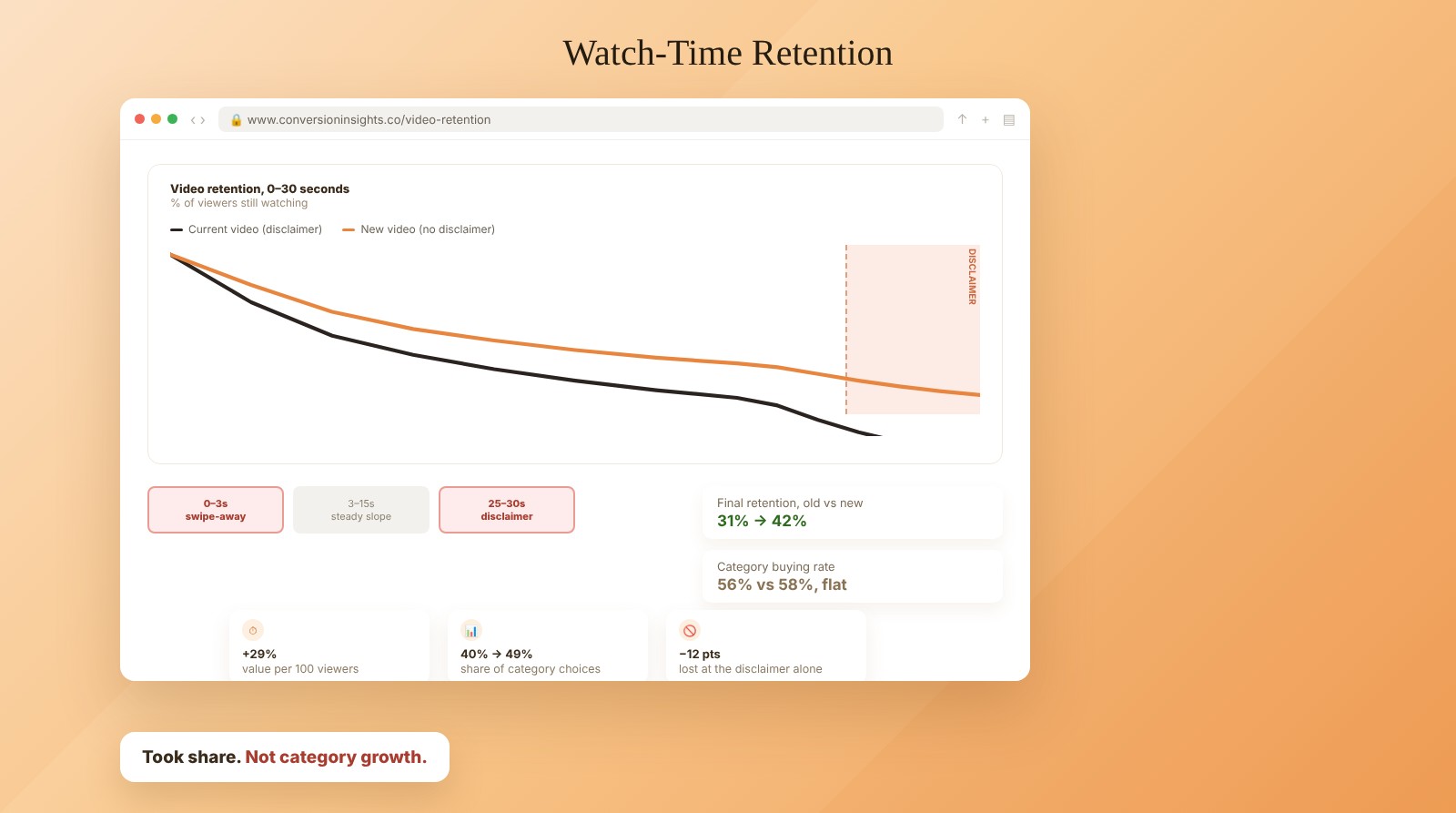
We tested two 30-second creator videos for the same supplement, monadically, in a full TikTok Shop replica: same creator format, same product tag, same length. The new video outsold the old one by 29% in value per 100 viewers. The single biggest gap between them opened in the last five seconds of the old video, the moment its legal disclaimer started.
That timing is not a coincidence, and it is not the only thing the test found.
Both videos lose viewers in the same place, at first
Every short-form video bleeds viewers in the opening seconds, and these two were no exception: the current video lost 22% of viewers in the first three seconds, the new one 16%. Both then declined at a similar, steady rate through the middle of the video, roughly two points a second, while the creator told her story. By the 15-second mark the new video held a real but unremarkable lead, 62% of viewers retained against 52%.
Then the old video hits its disclaimer
In the final five seconds, the current video's legal disclaimer begins, and retention drops twelve points in that window alone, more than twice the decline of any other five-second stretch in the video. The new video, which carries no disclaimer, loses nine points over the same stretch and finishes at 42% retention against 31% for the old one. The gap between the two videos roughly doubles in exactly the five seconds where one of them has to stop telling its story and start reading legal text.
That is not a creative failure. The new video's opening and pacing weren't dramatically better, they were a few points better, consistently, the whole way through. The disclaimer is a structural cost that only one of the two videos pays, and it costs more attention, in this test, than the entire rest of the creative difference between them.
It took share. It didn't grow the category.
Here is the finding that matters most for how you read the win. Buying rate for the product's broader category, measured across every vitamin brand visible in the shop, was flat between the two cells: 56% of viewers bought a category product after the old video, 58% after the new one, a gap too small to call significant. The new video did not bring new buyers into the category. It moved existing category demand toward this product specifically, lifting its share of category choices from 40% to 49%, mainly at the expense of a lower-priced rival brand whose share fell from 10% to 6%.
A video that lifts your own buying rate 27% to 32% while the category stays flat has won a real, measurable fight for share. It has not expanded the pie, and reporting it as category growth would be the wrong read on an otherwise genuine result.
Why shoppers bought, and why some didn't
The reasons shoppers gave for buying stayed consistent with the category's core promise, efficacy: belief that the product repairs nerve damage rose from 48% to 52% as a purchase driver, and belief it treats nerve pain specifically from 39% to 43%. What the new video added on top was speed and duration, "acts quickly" roughly doubled as a stated reason (9% to 19%), as did "lasts the right duration" (7% to 17%).
Price stayed the single largest barrier for non-buyers in both cells, essentially unchanged at 32 to 33%. But the old video left more shoppers doubting the product worked at all, 17% of its non-buyers versus 11% for the new one, and more shoppers stating outright negative intent, 11% versus 7%. The new video didn't remove the price objection. It reduced the number of people who rejected the product on credibility before price ever became the question.
What to check before calling a creative test a win
Look for where in the video attention actually drops, not just the average watch time, because a flat average can hide a cliff at a specific second that a structural fix, not a creative one, would solve. And before reporting a lift as growth, check the category number alongside the brand number: a video can be a genuine, worthwhile win on share and still be exactly what the category was already going to sell, just to a different brand.